¶ Cartography
Living in an asteroid belt instead of on a planet is a unique part of life here in Adalia. Here is a basic summary of the terms that the Coastin Cartographic Society has developed for describing locations within an asteroid belt.
¶ Map Of Adalia
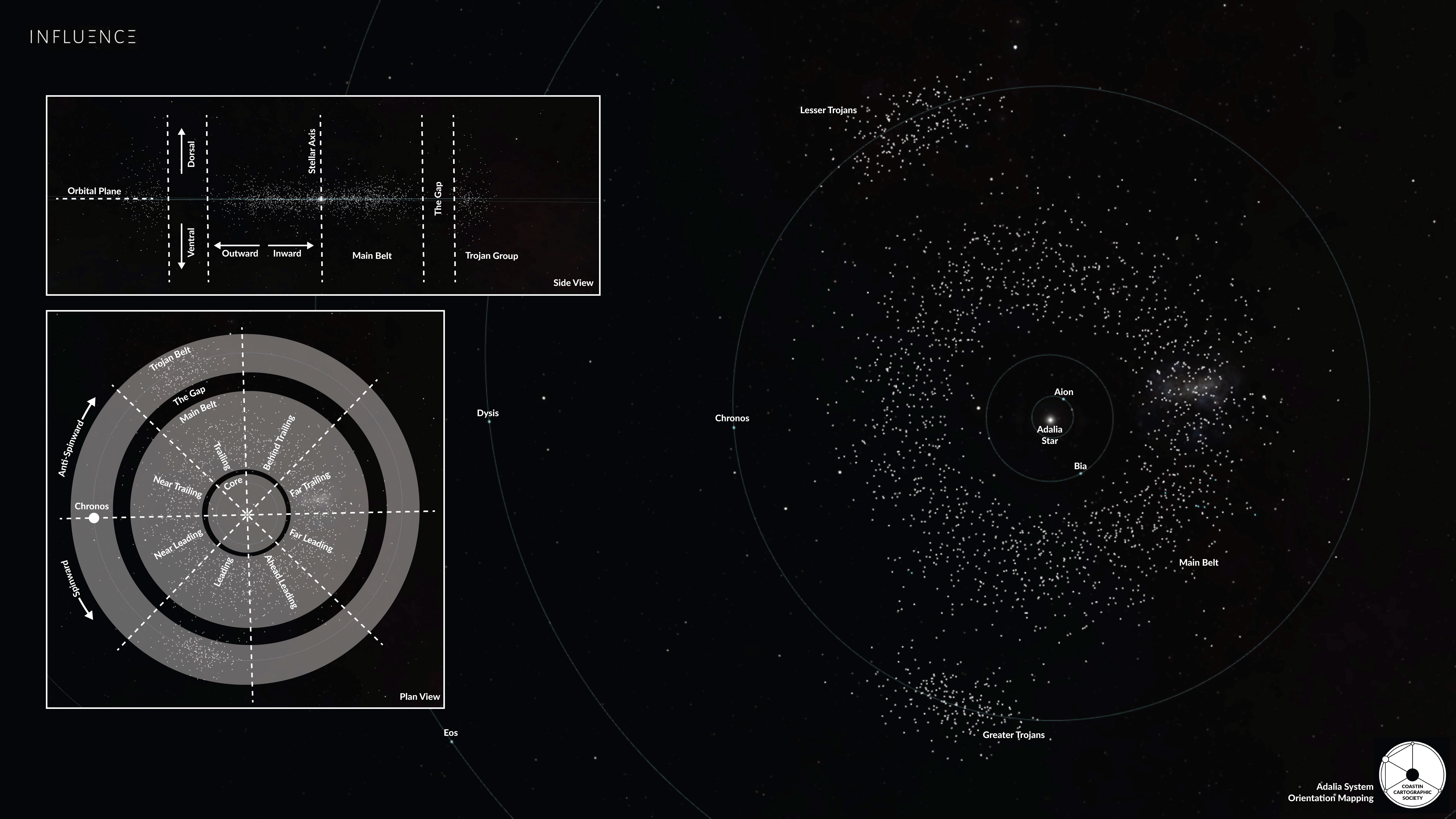
¶ The Six Cardinal Directions:
¶ Spinward
Prograde; in the direction of orbit; counter-clockwise when viewed dorsally.
¶ Antispinward
Retrograde, in the opposite direction of orbit; clockwise when viewed dorsally.
¶ Inward
Toward the star Adalia.
¶ Outward
Away from the star Adalia.
¶ Dorsal
Above the orbital plane while spinward is counter-clockwise.
¶ Ventral
Below the orbital plane while spinward is counter-clockwise.
¶ The Adalia System
The Adalia star system is compromised of the star Adalia, five planets, and an asteroid belt.
¶ Adalia
Adalia is both the name of the star Adalia and also the name of the whole Adalia star system. The humans living in the asteroid belt of Adalia are known as Adalians.
¶ The Star Adalia
Also known as “Adalia Star”, “the star”, or somewhat inaccurately as “the sun”, Adalia is a main sequence star slightly smaller than Sol (the Earth’s Sun). Its exact specifications:
* Diameter: 0.886 times that of the Sun, or just over 1.2 million kilometers
* Mass: 0.86 times that of the Sun, or 1.71 * 10^30^ kilograms
* Surface temperature: 0.914 times that of the Sun, or 5281 Kelvin. In color terms, orangeish white.
* Luminosity: 0.547 times that of the Sun, or 2.11 * 10^26^ watts
* Spectral type: K0V, a main sequence K-dwarf approximately 6.4 billion years old.
¶ The Planets
Upon Arrival, the five planets were designated as A, B, C, D, and E by order of distance from the star Adalia. They were subsequently given names by the Coastin Cartographic Society.
¶ Aion
Aion (or A) is a small, hot, rocky planet orbiting closest to the star. It is slightly smaller, faster, and closer to the star when compared to Mercury.
Aion completes an orbit roughly every two Adalian months, or slightly less than half an orbit each month. For this reason, an “Aion” is a somewhat unofficial term for an Adalian month.
Aion is named for the Greek deity representing endless, cyclical time.
¶ Bia
Bia (or B) is a rocky planet with a thin atmosphere and both land and seas, although it is far too hot for liquid water, so the sea is made of something else. It is slightly larger than Mercury, but orbiting closer to where Venus orbits in the solar system.
Initially it was hoped the Bia could be settled by the Arvad, but the first planetary scans quickly revealed that this would be impossible, forcing the settlement of the asteroid belt between Bia and Chronos instead.
Bia is named for the Greek deity representing force, anger, and raw energy.
¶ Chronos
Chronos (or C) is a gas giant roughly the size of Jupiter, although orbiting somewhat closer to its star.
The current position of Chronos in it’s orbit is used as a landmark by the Coastin Cartographic Society to determine relative positions in the belt.
Chronos is also the anchor for two Trojan clusters co-orbiting with it at Lagrange points L4 and L5.
Chronos is named for the Greek deity representing measured time
¶ Dysis
Dysis (or D) is a gas giant, smaller than Chronos but still quite large.
The confluence of Chronos and Dysis is regarded culturally as the "time of sunset and darkness", and an occasion to celebrate with scary stories and lighthearted spooky fun.
It is named for the Greek deity representing the sunset.
¶ Eos
Eos (or E) is a gas giant, and the fifth and final known planet of the Adalia system.
It is named for the Greek deity representing the dawn.